
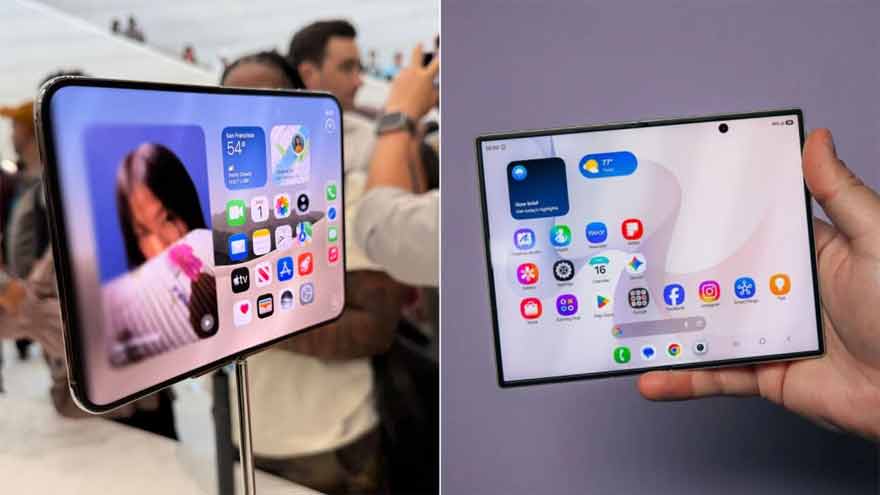
Summary The iPhone Duo officially launches on Oct. 23, so a full review will have to wait until then. In the meantime, I’ve spent plenty of time with its biggest rival, Samsung’s Galaxy Z Fold 8.
After months of rumors and speculation, Apple has finally unveiled its first foldable iPhone, the iPhone Duo. Following the “Surprise and Shine” keynote, one of Mashable’s senior reporters got a chance to go hands-on with the device in a packed demo room at Apple Park.
The iPhone Duo officially launches on Oct. 23, so a full review will have to wait until then. In the meantime, I’ve spent plenty of time with its biggest rival, Samsung’s Galaxy Z Fold 8.
So, how do these two flagship foldables stack up?
iPhone Duo vs. Galaxy Z Fold 8: Price
Before Apple’s iPhone event, rumors suggested the iPhone Duo could cost anywhere from $2,000 to $2,300. The final $1,999 starting price therefore came as a pleasant surprise.
That’s still a significant investment, of course. Samsung’s Galaxy Z Fold 8 isn’t exactly cheap either, starting at $1,899.99. Both models include 256GB of storage at the entry level, with higher-capacity versions available.
Apple pushes the price considerably higher with the 2TB iPhone Duo, which costs a staggering $3,199. Samsung does not offer a 2TB version of the Z Fold 8.
iPhone Duo vs. Galaxy Z Fold 8: Design
Based on the leaks, I wasn’t convinced Apple had made the right design choices. The rounded corners and D-shaped outer display reminded me of the Google Pixel 11 Pro Fold — and not necessarily in a good way.
After seeing the finished product, though, I’m happy to admit I was wrong. Apple appears to have nailed the design.
The iPhone Duo has a sleek, futuristic appearance, and unfolding it gives the phone a more sculptural feel. The Galaxy Z Fold 8, by comparison, looks somewhat boxier and more utilitarian.
Both devices are impressively thin. The iPhone Duo measures just 5.2mm when unfolded, making it Apple’s thinnest phone ever. Samsung goes even further, with the Z Fold 8 measuring just 4.5mm when open. Samsung’s foldable is also noticeably lighter.
iPhone Duo vs. Galaxy Z Fold 8: Displays and creases
Here’s how the two phones compare on paper:
iPhone Duo: 7.6-inch inner Super Retina XDR display and 5.4-inch outer Super Retina XDR display
Galaxy Z Fold 8: 7.6-inch inner AMOLED display and 5.5-inch outer display
One of the iPhone Duo’s biggest display advantages could be Apple’s premium nano-texture finish. By reducing reflections, the technology should make the foldable’s crease even harder to notice. In early photos and videos, the crease appears to almost disappear.
Combined with Apple’s Liquid Glass interface and Super Retina XDR technology, the nano-texture display looks extremely impressive and could be difficult for Samsung to match.
That said, the Galaxy Z Fold 8 is no slouch. Its AMOLED panels are excellent, and Samsung has also managed to make the crease nearly invisible. There’s a reason Apple reportedly turned to Samsung to manufacture the iPhone Duo’s flexible display.
iPhone Duo vs. Galaxy Z Fold 8: Cameras
In my Galaxy Z Fold 8 review, I identified the camera system as one of the phone’s biggest weaknesses. If you want a truly Pro-level camera setup, you’ll need to step up to the more expensive Galaxy Z Fold 8 Ultra.
The iPhone Duo, at least on paper, appears to make fewer compromises.
Here’s the camera breakdown:
iPhone Duo: 48MP main camera, 48MP ultra-wide camera, 12MP Center Stage selfie camera and an under-display FaceTime camera
Galaxy Z Fold 8: 50MP wide camera, 50MP ultra-wide camera and 10MP selfie camera
At first glance, Samsung’s 50MP sensors might seem like an automatic win over Apple’s 48MP cameras. But megapixels aren’t everything. Image quality also depends heavily on processing, and Apple’s new A20 Pro chip could give the iPhone Duo a significant advantage.
There is, however, one area where Samsung remains ahead: AI-powered photo editing. Apple is only now introducing AI photo-editing features with iOS 27 that have been standard on Galaxy devices for several years.
We’ll need to test the iPhone Duo’s cameras properly before making a final judgment, but the selfie setup already looks promising.
Samsung’s 10MP selfie camera was one of my biggest frustrations with the Z Fold 8. It takes up valuable space on the inner display while delivering an experience that feels difficult to justify.
The iPhone Duo’s under-display FaceTime camera could also have compromises in image quality, but at least it doesn’t occupy valuable screen real estate.
Apple also gives the Duo a second Center Stage selfie camera on the rear. On other iPhone models, Center Stage has proved useful for taking both vertical and horizontal selfies without having to flip the phone around, along with other framing benefits.
On paper, then, Apple appears to have built a more versatile camera system into its first foldable. The real test will come when the iPhone Duo reaches consumers and we can compare the cameras side by side with Samsung’s latest foldable.